

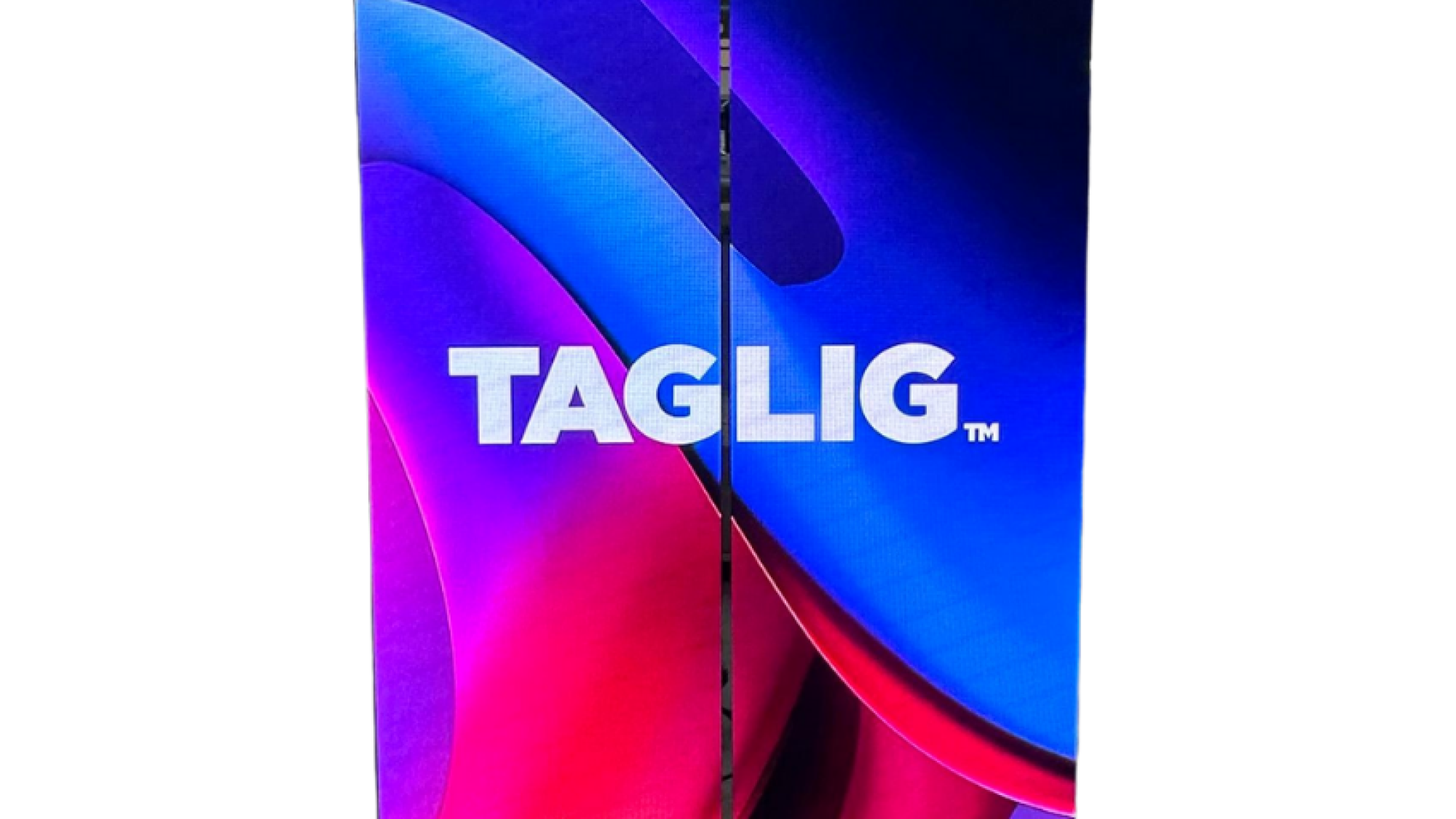
In a shop window, a mall corridor or a trade show booth, the fastest way to catch attention is a bright, moving image. An LED poster is a free-standing, portable digital display that replaces the printed poster. Plug it in, upload your content and it is live; when the campaign changes, you update the file from your phone instead of ordering a new print. This article explains what an LED poster is, where it works best in a store and what to check before you buy one.
What Is an LED Poster?
An LED poster is a high-resolution indoor LED display built into a slim cabinet. Its tall, roughly human-height format makes it the digital equivalent of a poster stand. It needs no installation, does not have to be wall-mounted and can be moved to a new spot whenever needed.
Key specifications of the Taglig LED Poster:
- Size: 192 cm high × 64 cm wide
- Pixel pitch: GOB P1.86 mm – sharp images even at close viewing distance
- Brightness and refresh rate: 800 nits, 3840 Hz
- Connectivity: built-in Wi-Fi, USB, HDMI, LAN, mobile app and cloud management
- Weight and protection: 51 kg, IP40
- Power: 220 W average, 750 W maximum
- Flexibility: foldable, and several posters can be joined side by side
See the LED Poster product page for photos and full details.
Where to Use an LED Poster in a Store
Because it stands at eye level along the customer’s walking path, an LED poster delivers the most value in these spots:
- Behind the shop window: shows the new season, a discount or a product video to people walking past. Moving content is noticed from much further away than a static print.
- At the entrance: welcome messages, today’s offer or loyalty programme announcements.
- Near the checkout and waiting areas: where customers wait a few minutes, it promotes add-on products and services.
- At the end of an aisle: short looping videos for a specific brand or product range.
- Mall corridors and exhibition stands: since it is portable, the same screen can be reused in rented spaces and temporary events.
Several posters can also be joined to form a wider digital wall – a practical option for stores that want a continuous image along the full window.
LED Poster vs Printed Poster vs LCD Display
| Criterion | Printed poster | LCD display | LED poster |
|---|---|---|---|
| Changing content | New print for every campaign | Digital, usually via a media player | Digital; instantly via app, cloud or USB |
| Video and animation | No | Yes | Yes |
| Visibility behind glass | Depends on lighting | Can wash out in a sunny window | 800 nits for better readability in windows |
| Joining several units | – | Visible bezels | Can be joined side by side |
| Moving and setup | Easy | Usually needs mounting | Free-standing, plug and play |
In short, a printed poster serves one campaign, while an LED poster lets you run different messages all year on the same screen. For a broader comparison of display technologies, read our article LED screen vs LCD screen.
How Content Is Managed
The biggest advantage of an LED poster is that store staff can change the content without a technical team. With built-in Wi-Fi and the mobile app, an image or video can be uploaded from a phone. Cloud management lets retail chains update posters in every branch from one place. Where there is no internet, a USB stick works; for permanent setups, HDMI or LAN can be used.
A few practical tips for effective content:
- The screen is vertical, so design content in portrait format (about a 1:3 ratio) rather than squeezing in a landscape video.
- Deliver the message in the first 3–5 seconds – passers-by will not watch a long clip.
- Use large text, high contrast and one clear call to action (for example “30% off inside”).
- Schedule different content by time of day: breakfast menu in the morning, evening offers later.
What to Check When Choosing an LED Poster
- Pixel pitch: if customers view the screen from 1–3 metres, a fine pitch is essential. P1.86 gives a smooth image at close range. See our LED screen pixel pitch guide for details.
- Surface protection: a GOB (Glue on Board) surface adds a protective layer over the LEDs – a real advantage in stores and exhibitions where people may touch the screen or it may be knocked during transport.
- Refresh rate: 3840 Hz reduces flicker and scan lines when the screen is filmed with a phone camera, which matters in stores where customers photograph the window.
- Ease of use: look for an app and cloud support that let store staff update content themselves.
- Environment: IP40 is an indoor rating. For outdoor use, consider our outdoor LED screen models.
Taglig’s Experience in Retail and Commercial Spaces
Taglig manufactures LED screens at its factory in Merzifon, Türkiye, and has long worked in high-traffic commercial spaces. At İstmarina Shopping Mall in May 2018 we installed Vega P5 and P8 screens totalling 253.77 m². At Istanbul Airport we installed 36 double-sided Sirius P2.5 screens over the baggage carousels in October 2018 (536 m² in total) and a 107 m² Vega P5 screen at the international terminal passenger exit in February 2019. At the ISE exhibition in Amsterdam in January 2017, our stand featured a 60 m² Sirius P2.5 screen. The LED Poster brings this experience to store scale as a solution that needs no installation. You can see more of our work on the projects page.
For a quote based on quantity and your use case, simply fill in our get a quote form.
Frequently Asked Questions
Does an LED poster need installation?
No. The LED poster is free-standing and plug and play. Plug it into a socket, upload your content and it is ready; wall mounting is not required.
How do I upload content to an LED poster?
Content can be uploaded over built-in Wi-Fi via the mobile app or cloud management, as well as through USB, HDMI and LAN. Retail chains can update all branches centrally via the cloud.
Is an LED poster visible behind a shop window?
The Taglig LED Poster offers 800 nits brightness and is suitable for indoor use behind a shop window. It is not intended for direct outdoor use exposed to rain and sun; outdoor LED screens should be used there.
Can several LED posters be combined?
Yes. Taglig LED Posters can be joined side by side to create a wider digital display, and their foldable design allows different layouts.
How much power does an LED poster use?
The Taglig LED Poster consumes 220 W on average and 750 W at maximum. Actual consumption depends on the brightness and colours of the content.
How is the price of an LED poster determined?
The price depends on quantity, whether units will be combined, content management preferences and delivery location. For a current price, fill in Taglig’s quote form or call us on +90 532 375 95 72.